










Israel has one of the largest economies in the Middle East, with a tech sector that’s often compared to Silicon Valley. Its world-renowned startup culture makes it an attractive destination for companies looking for talent. But labor regulations can block your global hiring goals.
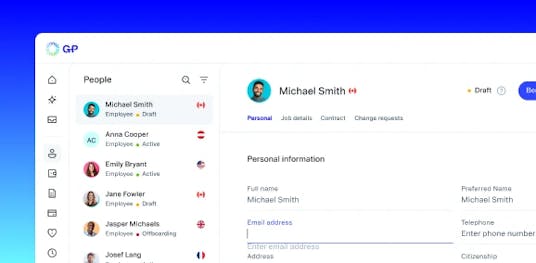
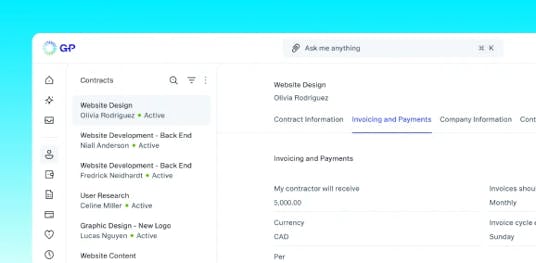
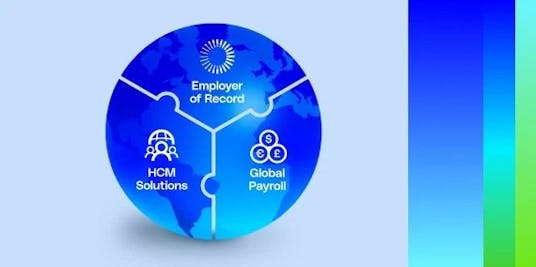
An Israel employer of record (EOR) helps you navigate these complexities with ease. As a global EOR, G-P takes care of payroll , employment contracts, benefits, and more. You can hire quickly and compliantly, without the time and cost of entity setup.
Simplify hiring in Israel with an employer of record
An EOR acts as the legal employer for your team members, so you can’t hire anywhere, without the legal complexities.
An Israel EOR, like G-P, ensures you comply with the country’s National Health Insurance Law and Foreign Workers’ Law. We manage the entire employment lifecycle — from onboarding to offboarding — so you don’t have to.
The EOR hiring process in Israel:
-
Partner with a global employment expert. Choose an EOR with deep expertise in Israel as they’ll guide you through the local legal landscape.
-
Source your ideal candidate. You find the best talent, and the EOR handles the rest.
-
Generate a compliant employment contract. Your EOR drafts a locally compliant contract in line with Israel’s labor laws, including salary, working hours, and notice periods.
-
Onboard and manage your team. The EOR manages the entire employment lifecycle, including payroll and administering benefits.
Employment contracts in Israel
A written employment contract is only mandatory for workers who aren’t citizens or permanent residents, but we recommended giving one to all workers.
Employers must give every employee, whether temporary or full-time, a written “notice to employee” within 30 days of their start date.
This notice outlines all main employment terms, such as compensation , benefits, and termination requirements. The notice can be in Hebrew or in a language the employee understands. If it’s in the latter, the employee must confirm in writing that they got the notice, read it, and understood it. We suggest the employee signs the notice as proof of receipt, although this isn’t a legal requirement.
Employers don’t need to provide the notice to employee if a written employment contract contains the required employment terms. Many employers provide both documents anyway.
An offer letter and employment contract should state salary and compensation amounts in Israeli new shekels (ILS). It’s standard to include confidentiality and intellectual property clauses. However, Israel’s courts only enforce noncompete clauses when they’re reasonable and protect an employer's legitimate business interests.
An Israel EOR, like G-P, ensures employment contracts follow Israel law and best practices. This simplifies onboarding and minimizes compliance risk.
Leave entitlements in Israel
Working hours in Israel
The standard workweek is Sunday to Thursday. The maximum workweek is 42 hours, usually made up of four 8.6-hour days and one 7.6-hour day.
The weekly rest day for Jewish employees is Saturday. Non-Jewish employees can choose Friday, Saturday, or Sunday as their main weekly rest day.
Overtime is paid as follows:
-
First two hours: 125% of the regular hourly wage
-
Subsequent hours and work on a rest day: 150% of the regular hourly wage
Certain roles, such as senior management, can instead get an agreed-upon, set monthly overtime payment based on the nature of the role. This must be stated in the employment contract.
Employees can’t work more than 12 hours in one day or 58 hours in one week, including all regular and overtime hours.
Public holidays in Israel
Employees in Israel get nine paid public holidays. All employees get these days off, whether they’re Jewish or not. Current national holidays are:
-
Pesach (two days)
-
Yom Ha'atzmaut
-
Shavuot
-
Rosh Hashanah (two days)
-
Yom Kippur
-
Sukkot
-
Simchat Torah/Shemini Atzeret
Non-Jewish employees may substitute their own religious holidays for the Jewish ones, but if the workplace closes for a Jewish holiday, they may need to use vacation days or unpaid leave.
Vacation days in Israel
Legal minimum annual leave is based on years of service with a company. Annual leave is expressed in calendar days, not working days.
The legal minimum for an employee working a five-day workweek is 16 calendar days per year for the first five years, which equals 12 working days. This increases based on how long the employee is with the company.
-
Years one to five: 16 calendar days or 12 working days
-
Year six: 18 calendar days or 14 working days
-
Year seven: 21 calendar days or 15 working days
-
Years eight to 13: 23 calendar days or 16 working days
-
Year 14 or longer: 28 calendar days or 20 working days
Sick leave in Israel
Employees accrue 1.5 days of sick leave per month, with a maximum accrual of 90 days. Sick pay is paid by employers as follows:
-
Day 1: Unpaid
-
Days two and three: 50% of regular salary
-
Day four onward: 100% of regular salary
Many collective agreements or employers offer more generous terms, such as full pay from the first day of sickness.
Maternity, paternity, and childcare leave in Israel
Maternity leave length depends on how long an employee has worked for an employer. Part of the leave is paid and part is unpaid – unless the employer provides additional benefits. The National Insurance Institute (NII) covers the paid portion. How much maternity leave is paid depends on how long the employee has contributed to the NII.
|
Months of service with employer |
Total maternity leave |
|---|---|
|
12 or more |
26 weeks |
|
Less than 12 |
15 weeks |
|
Months of paying NII contributions |
Paid leave |
|
At least 10 of the 14 months before maternity leave |
15 weeks |
|
Less than 10 of the 14 months before maternity leave |
8 weeks |
Fathers get five days’ paternity leave. The first three are from annual leave, the next two from sick leave. They are paid 50% of their regular wage for the two sick days. If the employee has no accrued annual leave, these days are unpaid.
Mothers must take at least six weeks’ maternity leave. Fathers may share the rest of the maternity leave with the mother after the first six weeks, subject to NII eligibility. The mother must return to the workforce if the father takes the rest of the leave.
Employees who have worked for a company for six or more months are protected from dismissal. A pregnant employee or an employee who has just given birth can’t be dismissed:
-
During maternity leave
-
For 60 days after they return to work, except with a special permit from the Ministry of Labor
An employee who has worked for the same employer for at least a year can take unpaid leave to care for their child. This leave can last up to one quarter of the period of employment with the employer, but not for more than one year.
Eligible mothers and fathers can take this leave. The employee’s job is protected during this period, and they’re entitled to return to their position.
How an employer of record in Israel helps manage leave entitlements
An Israel employer of record simplifies employee leave management. An Israel EOR, like G-P, understands NII regulations and handles contributions, leave entitlements, shared leave, and documentation.
Health insurance in Israel
All residents of Israel are entitled to healthcare. They must register with one of four official health organizations, called Kupot Holim.
Employers and employees pay mandatory contributions to the NII as part of social security (bituach leumi) deductions. Rates for NII contributions range from 3.55–7.6%, depending on how much the employee earns.
The national system doesn’t cover non-residents. According to the Foreign Workers’ Law, the employer must provide private health insurance in this case.
Supplementary benefits and bonuses in Israel
Many companies offer supplementary benefits to attract and retain talent. These include:
-
Supplementary private health insurance: To cover services not included in the state health basket, or for team members who are non-residents.
-
Study fund (keren hishtalmut): A tax-friendly savings plan, with contributions from employer (7.5%) and employee (2.5%). This is a highly sought-after benefit, especially for tech employees. Originally meant for continuing education, it’s now used as a medium-term savings fund.
-
Travel expenses: Employers must contribute to employees' travel costs to and from work. This is usually based on the cost of a public transport pass up to a daily maximum (ILS 22.60, subject to updates).
-
Company car: Often given to senior-level employees.
Employees get an annual convalescence payment (dmei havra’ah) after one year of service. The payment supports employee well-being and is intended to cover employee vacation and recovery expenses.
The payment is calculated as follows:
-
Convalescence payment = number of entitled days × official daily rate
Employees are paid for 5–10 days, depending on how long they’ve worked at the company. It’s paid as a lump sum, usually in the summer. Employees get this payment regardless of whether they were sick or went on holiday.
We recommend you budget 20–25% on top of gross salary for mandatory contributions and extra benefits.
How an employer of record helps with benefits in Israel
An Israel EOR manages employee benefits on your behalf. EORs handle mandatory contributions and advise on supplementary benefits so you can offer competitive packages to attract top talent.
Termination and severance in Israel
Employers and employees can terminate an employment contract with written notice. An employer can pay the employee instead of giving notice.
The employer must have a formal hearing (shimua) before a dismissal so the employee can state their case.
The legal minimum notice period for monthly salaried employees depends on how long they’ve worked for an employer.
-
First six months: One day for each month worked
-
Months 7–12: Six days plus 2.5 days for each additional month
-
After one year: One full month
An employee with at least one year of service gets severance pay, unless they’re dismissed for a serious reason. Severance pay is typically one month's salary for each year of employment. The severance component of the employee’s mandatory pension fund is used to cover this.
An Israel EOR ensures offboarding compliance by managing termination, notice periods, severance pay, and more.
Payroll and taxes in Israel
Israel has a progressive income tax system, with rates ranging from 10–50%.
A comprehensive pension plan is mandatory for nearly all employees, starting from age 21 for men and 20 for women. The minimum total contribution is typically 18.5% of the employee's gross salary. This is paid up to a maximum based on the national average wage, which is updated each year. However, it’s common for employers to make contributions on the full salary.
Contributions are split as follows:
-
Employees: 6%
-
Employers: 12.5% (typically 6.5% for pension and 6% for a severance component)
The employer's pension contribution also includes a component for disability and survivor or dependants’ insurance.
An Israel employer of record ensures you comply with payroll taxes and mandatory NII and pension contributions. An Israel EOR manages everything from calculating and withholding income tax to accurate reporting.
Choosing the right EOR in Israel
When choosing an employer of record Israel, consider the following:
-
Compliance expertise: The right EOR has in-depth knowledge of Israel's labor laws and tax regulations.
-
Comprehensive EOR solutions: Choose an EOR that manages all aspects of employment, including payroll processing, tax remittances, benefits administration, leave management, and offboarding.
-
Scalability and flexibility: The EOR should accommodate your needs, whether you're hiring a single employee or a global team , and grow with your business.
-
Technology and integration: An AI-powered EOR simplifies onboarding, management, and employee payment. Look for an EOR that integrates with existing HCM, PEO, or payroll systems to streamline operations.
-
Transparency and communication: Choose an EOR that offers clear communication channels, transparent pricing, and regular updates on compliance changes.
-
Reputation and references: Research the EOR's reputation, customer testimonials , and industry recognition to ensure they have a track record of reliability and success. As the #1 EOR according to all industry analyst reports , G-P has a solid reputation and extensive global employment experience.
-
Data security and compliance. Ensure your EOR follows strict data security protocols like GDPR. This is critical for protecting sensitive employee information and maintaining compliance.
Use G-P EOR for hiring in Israel
G-P EOR is the award-winning, AI-enabled global hiring solution that empowers startups , SMBs , and enterprise businesses to build global teams with ease. Onboard, manage, and pay top talent in over 180 countries in minutes, without the complexity of entity setup.
G-P EOR is the preferred partner for leading HCM, PEO, and payroll platforms . Bring your workforce data together in one place to maintain existing workflows while keeping consistent and accurate data across your integrated systems.
Request a proposal to start hiring in Israel today.