









South Africa combines a skilled workforce with a mature business environment and access to the African market. A growing tech sector and established financial services industry add to its appeal. Hiring here brings growth opportunities — and compliance complexity shaped by strong worker protections.
A South Africa employer of record (EOR) simplifies the process. As aglobal EOR, G-P manages payroll, contracts, termination, and more. With G-P, you can build your team in South Africa quickly and compliantly, without setting up a local entity or worrying about red tape.
Simplify hiring in South Africa with an employer of record
South Africa has a robust legal framework. The Basic Conditions of Employment Act (BCEA), Labour Relations Act (LRA), and Employment Equity Act shape everything from working hours to workplace fairness.
The BCEA defines minimum employment standards. Employers can offer more favorable terms, but not less.
A South Africa EOR, like G-P, manages these requirements. We act as the legal employer, handling payroll, contracts, and compliance — so you can build your team with confidence.
The EOR hiring process in South Africa:
-
Partner with a global employment expert. Choose an EOR with deep expertise in South Africa as they’ll guide you through the local legal landscape.
-
Source your ideal candidate. You find the best talent, and the EOR handles the rest.
-
Generate a compliant employment contract. Your EOR drafts a locally compliant contract in line with South Africa’s labor law, including salary, working hours, and notice periods.
-
Onboard and manage your team. The EOR manages the entire employment lifecycle. This includes managing your team members’ payroll and administering benefits.
Employment contracts in South Africa
Employment contracts can be verbal, but it’s best to have them in writing. Whether a contract is in writing or not, employers must give employees the core employment terms in writing once they start work.
The contract and core terms must be in a language the employee understands. It’s up to the employer to make sure the employee understands these terms.
Compensation amounts don’t legally need to be in South African rand (ZAR), but all statutory payments are made in ZAR, so we recommend using rand amounts for clarity.
Indefinite-term contracts are standard. Fixed-term contracts are only allowed for certain reasons, such as a time-bound project or covering a leave of absence.
A South Africa EOR, like G-P, drafts compliant contracts on your behalf. This reduces risk and sets clear expectations for your team.
Leave entitlements in South Africa
Working hours in South Africa
The standard workweek is 45 hours. Employees who work more than five hours in a row get a 60-minute unpaid meal break. This can be reduced to 30 minutes by written agreement or skipped if the employee works less than six hours a day.
Overtime is limited to 10 hours per week and needs mutual agreement. A written agreement can increase overtime to 15 hours per week, but not for longer than two months in a 12-month period. Overtime is paid at 1.5 times the employee's normal wage. Work on a Sunday is paid at double time, or 1.5 times the normal rate if Sunday is a regular workday.
These regulations generally don’t apply to senior management, traveling sales staff, employees who work less than 24 hours a month, and employees who earn above an annual threshold.
Public holidays in South Africa
Employees in South Africa get 12 paid public holidays. If a public holiday falls on a Sunday, the following Monday is a paid day off.
-
New Year's Day
-
Human Rights Day
-
Good Friday
-
Family Day
-
Freedom Day
-
Workers' Day
-
Youth Day
-
National Women's Day
-
Heritage Day
-
Day of Reconciliation
-
Christmas Day
-
Day of Goodwill
Vacation days in South Africa
Annual leave accrues based on days worked during a one-year leave cycle. For most employees, it accrues at one day for every 17 days worked, which is almost 1.25 days a month.
This means that employees who work a regular 5-day workweek get 15 working days of annual leave.
Sick leave in South Africa
Employers pay employees during sick leave.
Sick leave follows a 36-month cycle, starting from the employee’s first day of work with a new employer. Employees working a five-day week get 30 days’ paid sick leave each cycle. During the first six months working for a new employer, paid sick leave accrues at one day for every 26 days worked.
Unused sick leave is lost. Absences of more than two days in a row need a medical certificate. This also applies if the employee is absent more than twice in eight weeks.
The Compensation for Occupational Injuries and Diseases Act (COIDA) covers work-related injuries, illnesses, or death. Compensation is generally paid out by the fund, unless the employee is temporarily disabled for three days or less, as sick leave covers these payments. Employers register with the compensation fund and pay annual assessments.
Parental and family leave
South Africa’s parental leave laws are in transition.
The BCEA has separate categories and leave lengths for maternity, parental, adoption, and surrogacy leave. However, the country’s Constitutional Court ruled that this legislation must be changed to create a more equal, gender-neutral parental leave framework.
While these laws are being changed, employers must follow these directives:
-
Parents get four months and 10 days of unpaid parental leave per birth.
-
This can be shared between parents.
-
The birthing parent can take leave up to four weeks before the expected birth, or earlier if medically necessary. They can’t work for six weeks after birth unless medically certified.
The unemployment insurance fund (UIF) pays a portion of income during the leave period if the employer and employee have contributed to it. UIF benefits are generally paid on a sliding scale of 38–60% of the employee’s average salary, up to a maximum. Many employers top up these benefits.
However, UIF benefits are still based on the old categories and leave lengths. Until the South African Parliament updates the law, there’s a mismatch.
Employees take family responsibility leave for a child's illness or the death of a close family member. Employees with more than four months’ service and who work at least four days a week get three days’ of this leave per year.
How an employer of record in South Africa helps manage leave entitlements
A South Africa EOR ensures you comply with local leave laws by managing entitlements like annual and sick leave. They also take care of all parental leave and UIF submissions.
Health insurance and supplementary benefits in South Africa
South Africa has a public healthcare system, but private medical coverage is a key talent draw. Employers typically offer a group plan or a monthly allowance. Employer contributions towards private retirement funds is also common.
Bonuses in South Africa
A 13th-month bonus isn’t legally required, but it’s widely expected and often included in contracts. Performance-based bonuses are also common and typically tied to individual or company performance.
How an employer of record helps with benefits in South Africa
A South Africa employer of record manages and administers mandatory and supplementary benefits on your behalf. Using a South Africa EOR ensures you offer competitive benefits while complying with local regulations.
Termination and severance in South Africa
There’s no legal maximum probation length, but it should be reasonable for the job if included in a contract. During probation, employers must manage performance fairly, give feedback and support, and offer a chance to improve before dismissal.
Termination needs a fair reason and procedure. Valid grounds include misconduct, incapacity through poor performance or health, or operational reasons, such as job cuts. Employers must follow strict procedures set out in the LRA.
Dismissal based on discrimination, pregnancy, or participation in protected strikes is automatically unfair and can lead to significant compensation or reinstatement.
Employers have to give notice in writing. Legal minimum notice periods for employers and employees depend on length of service with that employer:
-
Less than six months: One week's notice
-
6–12 months: Two weeks’ notice
-
Over 12 months: Four weeks’ notice
Employees who are terminated get severance pay. This is at least one week's pay for each year of service. Severance isn’t paid for dismissal due to misconduct, poor performance, resignation, or retirement.
A South Africa EOR simplifies employee offboarding. EORs ensure your business complies with legal notice periods, severance, and more.
Payroll and taxes in South Africa
Social security contributions go to the UIF and skills development levy (SDL).
-
The UIF contribution is 2% of salary, which is capped and split equally between the employee and the employer. The salary cap is ZAR 17,712 per month for 2026. When an employee earns more than this, the UIF contribution is calculated only on ZAR 17,712, and not on their full salary.
-
The SDL is an employer contribution of 1% of total payroll. This applies to companies with an annual payroll of more than ZAR 500,000.
Personal income tax (pay-as-you-earn, or PAYE): Employers withhold employees’ personal income tax, which is remitted to the South African Revenue Service (SARS). Tax rates are progressive, ranging from 18–45%, depending on how much the employee earns.
A South Africa employer of record handles all aspects of payroll management, including mandatory PAYE withholdings and UIF contributions.
Choosing the right EOR in South Africa
When choosing an employer of record South Africa, consider the following:
-
Compliance expertise: The right EOR has in-depth knowledge of South Africa’s labor laws and tax regulations.
-
Comprehensive EOR solutions: Choose an EOR that manages all aspects of employment, including payroll processing, tax remittances, benefits administration, leave management, and offboarding.
-
Scalability and flexibility: The EOR should accommodate your needs, whether you're hiring a single employee or a global team, and grow with your business.
-
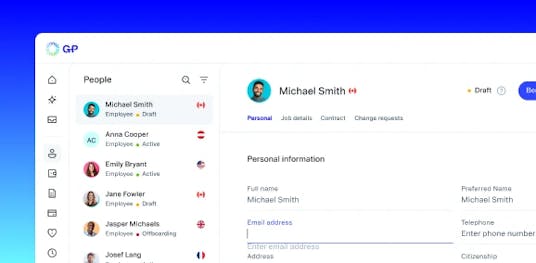
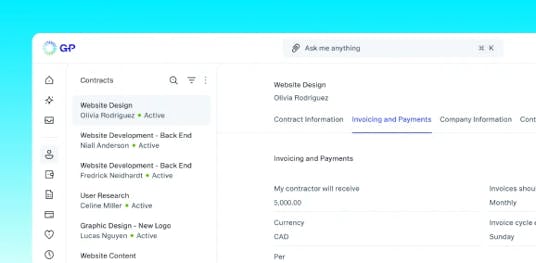
Technology and integration: An AI-powered EOR simplifies onboarding, management, and employee payment. Look for an EOR that integrates with existing HCM, PEO, or payroll systems to streamline operations.
-
Transparency and communication: Choose an EOR that offers clear communication channels, transparent pricing, and regular updates on compliance changes.
-
Reputation and references: Research the EOR's reputation, customer testimonials, and industry recognition to ensure they have a track record of reliability and success. As the #1 EOR according to all industry analyst reports, G-P has a solid reputation and extensive global employment experience.
-
Data security and compliance. Ensure your EOR follows strict data security protocols like GDPR. This is critical for protecting sensitive employee information and maintaining compliance.
Use G-P EOR for global hiring in South Africa
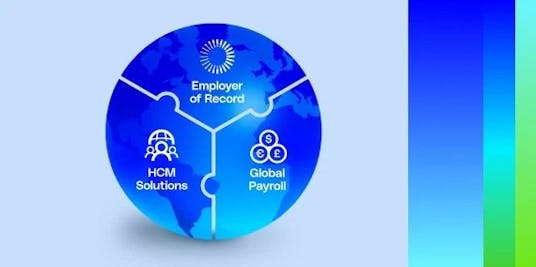
G-P EOR is the award-winning, AI-enabled global hiring solution that empowers startups, SMBs, and enterprise businesses to build global teams with ease. Onboard, manage, and pay top talent in over 180 countries in minutes, without the complexity of entity setup.
G-P EOR is the preferred partner for leading HCM, PEO, and payroll platforms. Bring your workforce data together in one place to maintain existing workflows while keeping consistent and accurate data across your integrated systems.
Request a proposal to start hiring in South Africa today.