







6 hidden costs of global hiring for France-based companies

When France-based companies consider international expansion, the conversation often starts with salary arbitrage – the prospect of hiring skilled global talent for a fraction of domestic costs. 

But here's what French executives often overlook: salaries are just the starting point. The true cost of international employment has many operational expenses hiding beneath the surface. While salary arbitrage is an easy sell for global hiring, it isn’t the full employment picture.

The key to successfully accessing international talent lies in understanding these additional costs upfront, allowing for accurate budgeting and realistic ROI projections. 

Let's look at six cost categories that catch France-based companies off guard  and how to plan for them effectively.

Cost #1: Entity setup and ongoing maintenance

Setting up a legal entity is a major investment that requires upfront payment, plus ongoing maintenance. Here are some of the cost implications:

  • Initial incorporation fees

  • Legal counsel for compliance

  • Accounting setup and systems

  • Local banking relationships

  • Annual maintenance costs

But the financial cost is only part of the equation. Entity establishment is also a time-consuming endeavor, typically requiring 3-6 months of setup before you can legally make your first hire. For France-based companies moving at startup speed, this delay represents missed opportunities and competitive disadvantages.

Cost #2: Employer social contributions and payroll taxes

Executives in France are familiar with high employer social contributions. However, international rates can be equally steep, and calculating them across multiple jurisdictions is a logistical nightmare. Here are some examples:

  • Germany: ~21% total employer social security contributions plus work accident insurance

  • Brazil: 20-28% in social contributions plus mandatory benefits like 13th-month salary

  • Italy: 29-35% employer social security contributions plus complex compliance requirements

The challenge for France-based companies lies not only in the rates themselves, but in understanding the nuanced calculations, caps, and reporting requirements across different countries. 

Cost #3: Compliance management

Managing payroll in France comes with a high administrative burden. It’s a juggling act for internal HR teams. Between calculating income tax, processing social contributions, applying Collective Bargaining Agreements (CBAs), and staying compliant with local deadlines, even experienced HR teams can feel overwhelmed. 

Here are some costs France-based companies will encounter:

  • Local legal counsel for employment law updates

  • Specialized payroll software for each jurisdiction

  • HR expertise for country-specific regulations

  • Translation services for employment documentation

  • Regular training for your HR team on international laws

Audit preparation and documentation costsadd another layer of expense. Each country has specific record-keeping standards, and maintaining compliance across multiple jurisdictions requires dedicated resources.

Cost #4: Currency and payment processing

What seems like a simple international wire transfer quickly becomes a complex web of fees that erode your cost savings. Currency exchange margins, transfer fees, and intermediary bank charges add up at scale. Here are some banking costs:

  • FX margins

  • International transfer fees

  • Intermediary bank charges

  • Local banking fees

  • Compliance reporting costs

Cost #5: Benefits and cultural expectations

France-based companies are no strangers to generous employee benefits. However, cultural expectations for additional compensation, allowances, or complementary insurance coverage can catch international employers off guard. For example:

  • Sweden: Up to 480 days of parental leave

  • Italy: 13th and sometimes 14th-month salary payments

  • Japan: Transportation allowances and overtime meal provisions

  • Mexico: Christmas bonus (aguinaldo) and vacation premium requirements

Benefits packages differ significantly by country, including health insurance, pension funds, 13th-month salary, and paid maternity leave. To attract top talent, France companies often need to exceed legal minimums to match local market expectations.

Cost #6: Termination and risk management

France-based companies understand termination complexity domestically, but international employment termination introduces new variables:

  • Notice periods vary by country and can extend several months

  • Severance calculations based on local formulas

  • Potential litigation costs and settlement fees

Beyond termination, risk management costs include professional liability insurance for international operations, intellectual property protection measures, and compliance monitoring systems that add ongoing operational expenses.

The G-P solution: transparent costs and predictable budgeting

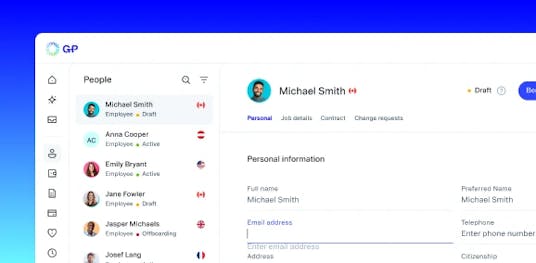
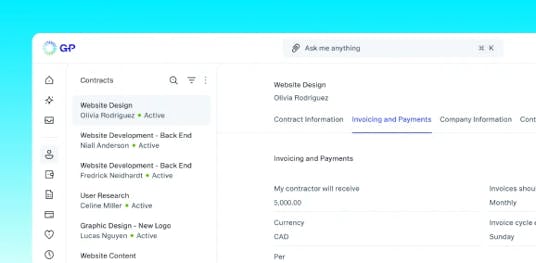
Instead of navigating this complex web of hidden costs, you can use G-P EOR for easy global hiring. Hire, onboard, and manage teams in 180+ countries, without the risk. We give you transparent pricing, allowing you to budget predictably while reducing many of the cost categories outlined above. With an EOR, you get:

  • Predictable monthly fee: One transparent rate per employee

  • No entity setup costs: Immediate market entry capability

  • Ongoing compliance management: Built-in legal and HR expertise, plus 24/7 agentic AI guidance

  • Simplified payroll processing: Multicountry payroll in one platform

  • Transparent benefits administration: Clear costs for competitive packages

This approach eliminates entity setup costs, reduces compliance risks, and gives you transparent pricing for easy budgeting. For France-based companies, this means focusing on new business opportunities rather than administrative complexity.

Ready to explore a more cost-effective method to global hiring? G-P EOR eliminates the unexpected costs and uncertainty of DIY international expansion, allowing you to scale globally with confidence and predictable budgeting.